A play area needs more than a soft-looking floor. It needs a surface that supports fall protection, stable footing, access, and daily use. It must also suit the space. Indoor areas may need low-emission materials and easy cleaning, while outdoor spaces need drainage and resistance to sun and rain.
Rubber playground mats are used in schools, parks, daycare centers, play gyms, apartment communities, and backyards. This guide explains how they work, what safety documents to request, and how to choose flooring for indoor and outdoor areas.
What Are Rubber Playground Mats?
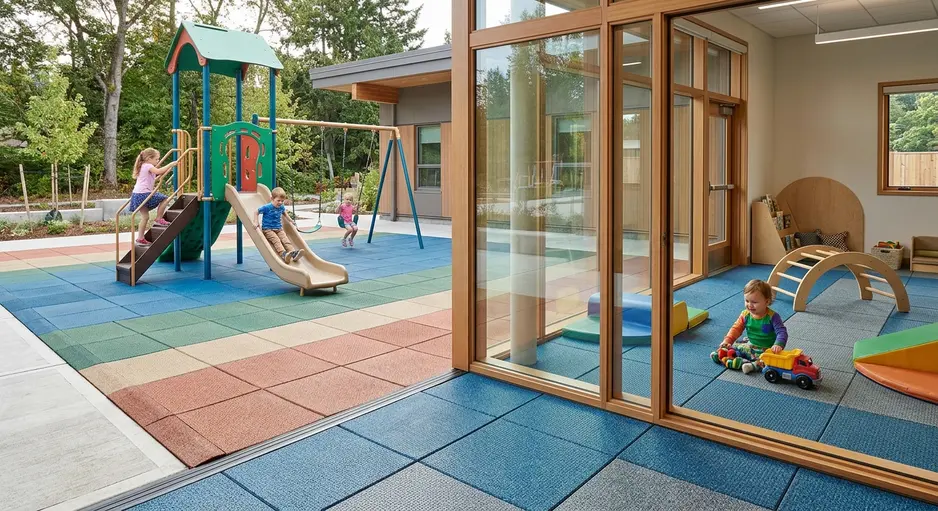
Playground floor mats are resilient sections of flooring designed for active play spaces. They may come as interlocking tiles, square mats, specialty pieces, or parts of a larger rubber flooring system. Unlike standard utility or gym mats, playground-rated products should have test data that supports their intended use.
How shock-absorbing playground mats work
Rubber compresses under force, creating cushioning underfoot and reducing some of the energy from a fall. This performance is known as impact attenuation. It can lower the risk of serious injury, but no surface can prevent every injury.
A product’s critical fall height is the maximum fall height at which the tested system meets a specified impact standard. This figure applies to the full system tested, including its thickness, density, base, and installation method. Thickness alone does not confirm performance.
Where rubber play area mats are used
- Public and private playgrounds
- Schools and daycare centers
- Indoor play centers and recreation facilities
- Backyard play structures
- Fitness and activity zones
- High-traffic play areas near slides and swings
Ordinary stable, anti-fatigue, or gym mats should not be treated as playground safety mats unless their documentation confirms that use.
How Safe Are Rubber Playground Mats?
The safety of rubber flooring for playgrounds depends on the tested product, the equipment height, site conditions, installation quality, and ongoing care. Material type alone is not enough to determine whether a surface is suitable.
Impact attenuation and critical fall height
Begin with the height of the playground equipment. In the United States, buyers can review the U.S. Consumer Product Safety Commission’s Public Playground Safety Handbook and request results based on ASTM F1292. EN 1177 is a key reference in many international markets.
Match the surface system’s tested critical fall height to the equipment and project requirements. Two mats of equal thickness may perform differently because of their density, underside design, wear layer, connectors, or substrate.
Slip resistance, drainage, and trip hazards
A slip resistant surface should provide stable footing in the conditions expected at the site. Outdoor areas need a plan for moving water away from the surface and base. Standing water may contribute to slippery areas, organic growth, frost damage, or movement beneath modular tiles.
Routine inspections should also find raised edges, widening seams, damaged transitions, and trapped debris. These issues can become trip hazards even when the flooring was installed correctly at first.
Playground safety standards and accessibility
ASTM F1292 addresses impact performance, while ASTM F1951 evaluates accessibility over playground surfacing. Projects in the United States may also need to follow the 2010 ADA Standards and U.S. Access Board guidance. IPEMA certification can provide third-party verification for listed products where applicable.
Accessible routes should remain firm, stable, and slip resistant. Transitions must allow people using wheelchairs and other mobility devices to enter and move through the play space.
Indoor vs. Outdoor Playground Mats
What should indoor playground mats provide?
Rubber playground mats for indoor spaces should be easy to clean and suitable for the building. Ask for documented material composition or emissions information rather than relying on broad claims such as “completely non-toxic flooring.” Indoor facilities should also review ventilation and odor expectations before installation.
Other priorities include acoustic comfort, stain resistance, secure seams, and fire-performance documentation required by local codes. A smooth cleaning routine matters in daycare centers and toddler zones, where spills and close contact with the floor are common.
What makes outdoor playground mats different?
Rubber playground mats for outdoors must cope with sunlight, rain, temperature changes, and heavy use. Depending on the climate, the system may need weather resistant rubber, UV resistant material, freeze-thaw tolerance, strong wear resistance, and effective water drainage.
Perimeter restraints help keep modular outdoor playground mats secure. The base should also direct water away from the play area. Surface channels alone cannot fix a foundation that holds water.
Can indoor rubber mats be used outdoors?
Only use them outdoors if the manufacturer specifically approves that application. Indoor-only materials may fade, curl, retain moisture, or break down after exposure to heat and weather. Check the technical data sheet, installation instructions, and warranty before choosing a product.
Which Type of Playground Rubber Flooring Is Best?
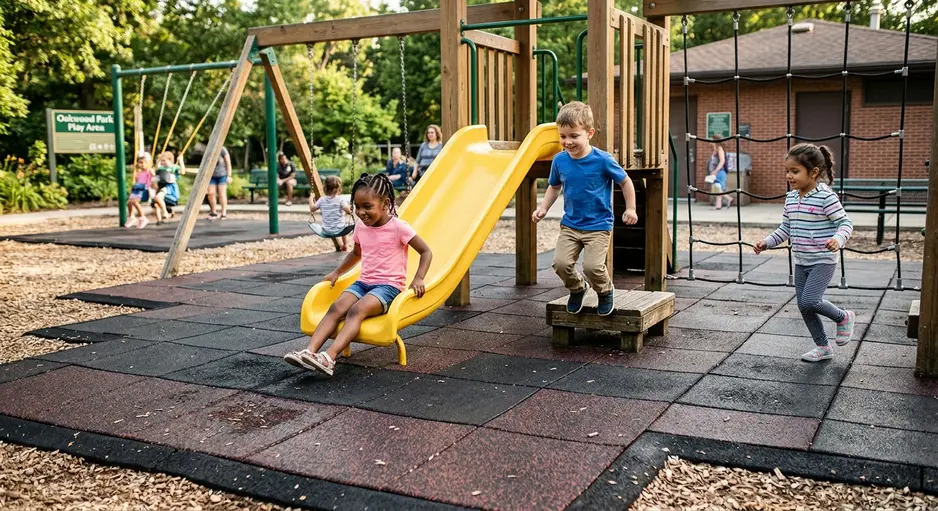
No single format suits every project. Compare fall-height performance, drainage, accessibility, repair needs, and installation conditions before selecting playground rubber flooring.
Interlocking playground mats and tiles
Interlocking playground mats can be installed in defined zones, and individual sections are often replaceable. This makes them useful where certain areas receive more wear than others.
However, the seams require inspection. Poor base preparation or trapped water may allow tiles to shift, separate, or settle. Replacement pieces must also be compatible with the original connector system and thickness.
EPDM playground mats and surfacing
EPDM is often used as a colored surface or wear layer. It offers broad color and design options and may provide good resistance to outdoor exposure when used in a suitable system.
Performance does not come from the EPDM layer alone. The impact layer, binder, thickness, substrate, and installation process all affect the finished surface.
Seamless rubber flooring
Poured-in-place or seamless rubber flooring can create custom shapes, color zones, graphics, and smooth transitions. It is often selected when a project needs a continuous child-friendly flooring design.
This format normally requires professional installation. Weather, mixing, base preparation, and curing conditions can affect the result. Worn areas may be repaired, but repairs can differ in color from the surrounding surface.
Rubber rolls and specialty mats
Rubber rolls may suit limited indoor activity areas, pathways, or other approved applications. Do not assume a standard roll offers fall protection flooring. Request product-specific impact and installation data before using it beneath play equipment.
Quick format comparison
- Interlocking tiles: Modular, repairable, and suitable for defined zones; seams need regular checks.
- EPDM systems: Colorful and flexible in design; performance depends on every layer.
- Seamless surfacing: Supports custom designs and smooth transitions; professional installation is usually needed.
- Rubber rolls: Useful for certain indoor spaces; not automatically playground rated.
How Do You Choose the Right Rubber Safety Mats?
Measure equipment fall height first
Identify the highest designated play surface and confirm the applicable fall height. Then compare it with independently tested product data. Avoid choosing a universal thickness based on appearance, price, or a general online chart.
Evaluate the base and drainage
Playground rubber flooring may be installed over concrete, asphalt, compacted aggregate, or an engineered base, depending on the system. The surface below it must be stable, even, and properly drained.
Rubber mats should not normally be laid directly over uneven grass or loose soil unless the complete system is approved for that foundation. Soil can settle, hold water, and create uneven edges.
Check performance documentation
- ASTM F1292 or EN 1177 impact test results
- Tested critical fall height for the complete system
- ASTM F1951 accessibility information
- Wet and dry slip-resistance data
- UV, weathering, and color-stability information
- Indoor fire-performance documents where required
- Material composition or emissions declarations
- Installation instructions and warranty terms
- Availability of compatible replacement tiles
Consider users, traffic, and climate
Toddler areas, school playgrounds, and public parks do not have identical needs. Consider user age, mobility access, daily traffic, shade, rainfall, snow, direct sun, and coastal exposure. Areas below swings and at slide exits may require closer inspections because wear is often concentrated there.
For product specifications, installation requirements, or a project quote, contact Rubbmat and provide details about the equipment, substrate, location, and expected use. Ask for current test documents related to the exact product being considered.
Installation and Maintenance Best Practices
Prepare the site correctly
- Confirm the dimensions, equipment layout, and required use zones.
- Inspect the substrate for cracks, low spots, and uneven sections.
- Plan drainage before installing the flooring.
- Acclimate the materials if required by the manufacturer.
- Use approved adhesives, connectors, and perimeter details.
- Check transitions for accessibility and trip risks.
Installation instructions are part of the tested flooring system. Changing the base, adhesive, underlayer, or connection method may affect performance and warranty coverage.
How do you clean playground rubber mats?
Sweep or vacuum loose dirt, leaves, and small objects. Use a manufacturer-approved neutral cleaner for routine washing. Outdoor surfaces may be rinsed where drainage allows. Remove spills, food, mud, and organic matter promptly.
Avoid harsh solvents and unapproved pressure-washing methods. Aggressive cleaning can damage the surface, loosen seams, or affect binders.
Create a documented inspection schedule
Inspection frequency should reflect site use and local requirements. Record the date, condition, and completed repairs. Pay close attention to:
- Loose, separated, or lifted seams
- Curling edges and damaged transitions
- Blocked drains and standing water
- Worn, hardened, or cracked areas
- Burns, vandalism, and embedded debris
- Changes beneath swings, slides, and climbing equipment
Real-World Selection Example
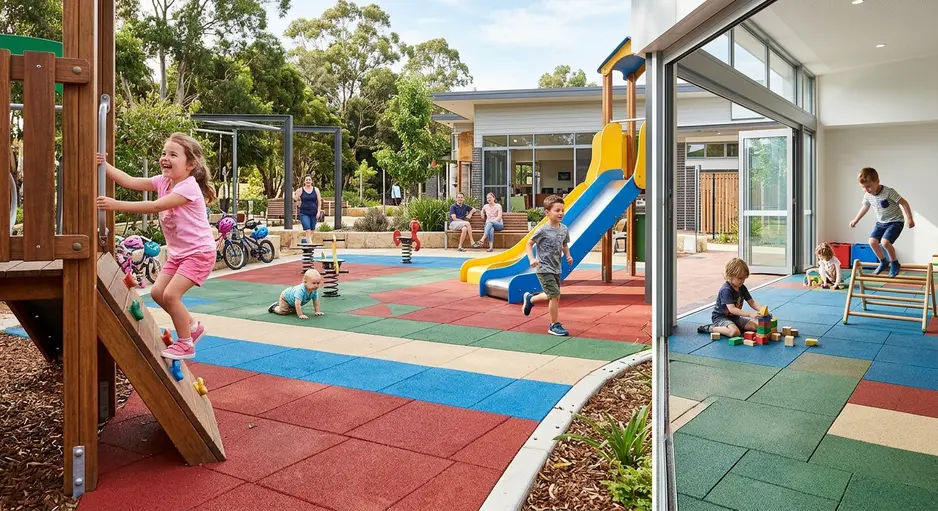
Illustrative mixed indoor-outdoor play center
Consider a facility with an indoor toddler room and an outdoor climbing area. For the indoor zone, the operator prioritizes secure seams, simple cleaning, acoustic comfort, fire documentation, and verified material information. The team also checks how ventilation and routine cleaning may affect odor.
For the outdoor zone, the equipment fall height is measured before flooring is selected. The project then compares tested shock absorption, UV stability, drainage, and weather performance. Stable transitions connect the play space to the accessible route.
Extra replacement tiles are retained for high-wear locations near slide exits. This plan makes small repairs easier and reduces the risk of a future color mismatch.
Common mistakes avoided
- Selecting flooring by color or thickness alone
- Installing over an uneven or unstable base
- Ignoring drainage and perimeter restraint
- Assuming every rubber product is suitable for children
- Failing to obtain current safety documentation
- Using an indoor product in an exposed outdoor area
Buy Best Rubber Playground Mats
Choose Playground Flooring as a Complete System
The best rubber playground mats are chosen according to equipment fall height, users, accessibility, drainage, climate, and documented test performance. Compare complete systems rather than relying only on thickness, color, or initial cost.
Explore rubber flooring options from Rubbmat or contact the team to request product specifications, installation requirements, test documentation, and guidance for your indoor or outdoor play area.
Frequently Asked Questions
1. How thick should rubber playground mats be?
Required thickness depends on the equipment fall height and the product’s tested impact performance. Density, construction, base, and installation also affect results. Use the complete system’s test report rather than a universal thickness recommendation.
2. Are rubber playground mats safe for toddlers?
They can be suitable when the system has relevant impact, slip, and material documentation. Secure edges, good cleaning, proper supervision, and routine inspection are also important in toddler areas.
3. Can playground mats be installed over concrete?
Some systems can be installed over concrete when the slab is stable, level, and properly drained. The selected build-up must provide the required tested fall protection. Follow the product’s base and installation requirements.
4. Do outdoor playground mats drain water?
Some tiles use channels, raised undersides, or permeable designs. Yet drainage depends on the entire system, including the slope and base. Water can still collect when outlets are blocked or the foundation is poorly designed.
5. Do rubber play area mats get hot in the sun?
Yes, surface temperatures can rise in direct sunlight. Color, shade, climate, airflow, and material composition can influence heat buildup. Site operators should check surfaces during hot weather before allowing use.