Horse walkways face constant wear from hooves, horseshoes, mud, water, cleaning products, and equipment. When the floor is hard, uneven, or wet, horses may lose confidence in their footing. Handlers can also find daily work more tiring and less safe.
Well-chosen horse walkway mats add cushioning, improve horse hoof traction, reduce noise, and protect the surface below. Yet the mat is only one part of a safe flooring system. Drainage, subfloor preparation, installation, and cleaning are just as important.
This guide explains how to select flooring and evaluate a horse walkway mat exporter for an international order. Buyers can also contact Rubbmat to confirm available products, specifications, customization options, and export terms for their project.
Why Use Rubber Horse Walkway Mats?

Bare concrete is strong and easy to find, but it can be hard on hooves and noisy under horseshoes. Smooth concrete may also become hazardous when it is covered by water, soap, manure, or mud. Compacted soil can offer softer footing, but it may become uneven and difficult to clean.
Rubber horse walkway mats create a resilient layer between the horse and the base floor. They are often used where facilities need better comfort, easier care, and protection against regular hoof traffic.
How Do Walkway Mats Improve Safety?
A textured, slip resistant surface can provide more reliable footing than smooth flooring. Better grip may help a horse move with greater confidence through aisles, entrances, grooming areas, and passages.
No floor is completely slip-proof. Mud, algae, detergent, loose bedding, and standing water can reduce grip on any material. Anti-slip horse walkway mats must therefore be supported by good drainage and regular cleaning.
Shock Absorption and Impact Protection
Shock absorbing rubber offers more cushioning than hard concrete. It can soften hoof-to-floor impact while reducing noise and vibration in enclosed barns. The resilient surface may also be more comfortable for handlers who spend long periods walking or standing in stable aisles.
These benefits should not be treated as medical claims. Sound hoof care, suitable bedding, safe handling, and proper facility management remain essential.
Moisture Control and Stable Hygiene
An easy-clean surface can make it simpler to remove mud, manure, and other debris. Low-absorption rubber may also limit the amount of moisture entering the flooring itself.
However, moisture can still collect at seams or beneath loose-laid mats. Close-fitting joints, a suitable subfloor slope, and a planned cleaning schedule are important for stable hygiene.
Choosing the Right Horse Walkway Mats
The right design depends on where the flooring will be used. Buyers should consider horse traffic, horseshoe use, climate, drainage, cleaning methods, and any carts or machinery that will cross the area.
What Thickness Is Best?
There is no single thickness that works for every stable. The required thickness depends on mat construction, size, density, substrate condition, and expected loads. A quiet private barn and a busy training center may need different products.
Before ordering, tell the supplier how many horses use the passage, whether they wear shoes, and what equipment travels over it. Ask for application guidance supported by load, tear, and abrasion information where available.
Surface Texture and Drainage Design
Common top patterns include pebble, hammer-top, diamond, checker, grooved, and ribbed finishes. A more pronounced texture may offer strong traction, but deep patterns can take longer to sweep and wash.
The underside may be flat, ribbed, or formed with drainage channels. Channels can help moisture move toward a drain, but they cannot correct a flat or poorly designed base. The complete floor system must direct water away from active walking areas.
Interlocking or Straight-Edge Mats?
Interlocking rubber mats connect along their edges. This can reduce lateral movement and visible gaps when the base is level and the pieces fit correctly. They are useful across larger areas where separate mats might otherwise shift.
Straight-edge mats can be easier to trim around doors, posts, and irregular walls. Individual sections may also be simpler to remove. Accurate cutting and edge restraints are important because open joints can trap dirt and moisture.
Neither design can compensate for a damaged subfloor. Depressions, loose material, and raised concrete can cause gaps, movement, or curled edges.
Rubber Quality Questions to Ask
Durable horse walkway mats should be assessed with more than appearance alone. Ask a prospective supplier for the specifications that apply to the offered product, including:
- Rubber composition, density, and hardness
- Tensile and tear strength
- Abrasion resistance for high-wear flooring
- Water absorption and moisture resistance
- Thickness and dimensional tolerances
- Indoor or outdoor suitability
- Temperature and weather resistant rubber properties
- Odor or emissions documents when required
Applications in Stables and Equestrian Facilities
Stable Walkways and Horse Aisles
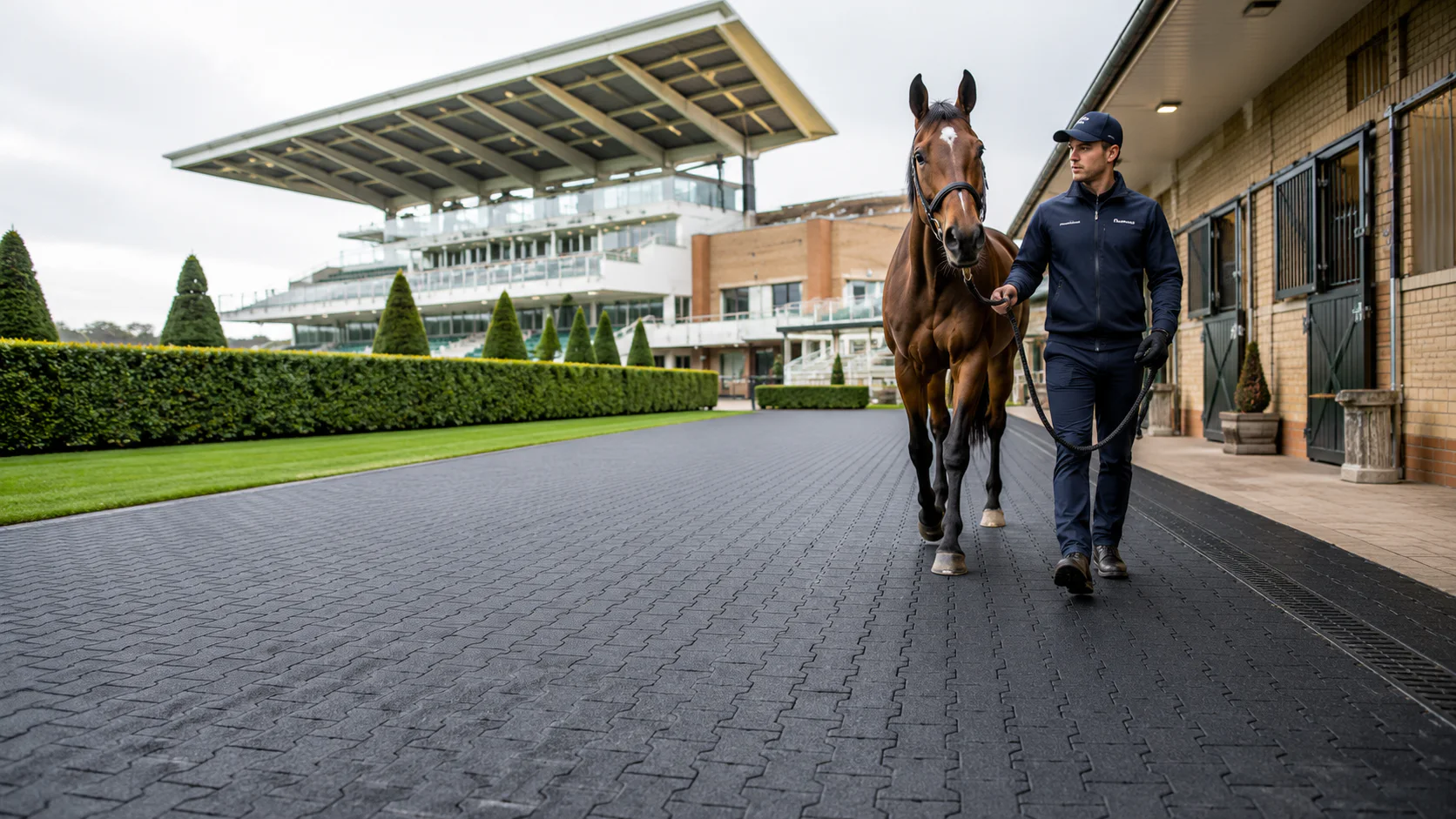
Horse stable walkway mats can be used in central aisles, cross-tie areas, entrances, grooming approaches, and passages near feed or tack rooms. Each area presents different risks. A wash approach needs moisture control, while an entrance may require a secure transition between surfaces.
Horse aisle mats should provide a stable route without raised joints or abrupt edges. In turning areas, the flooring must also resist sideways forces from hooves, carts, and wheelbarrows.
Barn Corridors and Farm Passages
Horse barn walkway mats often experience repeated wheelbarrow traffic as well as hoof wear. Horse corridor mats near exterior doors may also be exposed to rain, grit, and changing temperatures. Exposed edges should be secured or beveled to reduce trip hazards.
Horse farm walkway mats may be suitable for covered outdoor passages if the selected material is intended for those conditions. Outdoor installations need careful planning for sunlight, drainage, expansion, and temperature changes.
Other Equestrian Uses
Equine walkway mats may also be considered for veterinary facilities, breeding farms, boarding stables, training centers, competition venues, and loading routes. These applications fall within the wider category of equestrian facility flooring and livestock flooring solutions.
Can the Mats Handle Equipment Traffic?
Rubber mats for horse walkways may support wheelbarrows, feed carts, and similar equipment when correctly specified. Buyers should disclose wheel loads, tire type, traffic frequency, and turning patterns. Flooring intended for horses and pedestrians should not be assumed to support heavy vehicles.
Installation, Drainage, and Maintenance
Can Mats Be Installed Over Concrete?
Concrete is a common base when it is solid, clean, level, and properly sloped. Cracks, high spots, and depressions should be repaired before installation. Small pieces of debris must also be removed because they can create pressure points beneath the mat.
Installation may involve loose laying, edge restraints, or adhesive, depending on the product and site. Always follow the instructions provided for the selected horse flooring mats. If local building or drainage requirements apply, seek professional advice before work begins.
Do Horse Aisle Mats Need Drainage?
Drainage is important in areas exposed to washing, rain, or frequent moisture. A channel-backed mat may help guide water, but the water still needs a clear route to an appropriate outlet.
Plan the system around subfloor slope, drain location, seams, wash frequency, and expected water volume. Standing water can lower traction, increase odor, and make routine sanitation more difficult.
Preventing Movement and Raised Edges
- Prepare a flat, stable base before fitting the mats.
- Allow the product to acclimate when the supplier recommends it.
- Follow the stated expansion allowance for the rubber.
- Make accurate cuts around walls, drains, doors, and posts.
- Use secure ramps or beveled edges at exposed transitions.
- Inspect seams and high-traffic turning points regularly.
Fitting rubber too tightly can cause buckling when it expands. Leaving large gaps can encourage movement and collect organic material. The supplier’s installation guidance should take priority over a general rule.
Cleaning Horse Stable Rubber Flooring
Begin by removing manure, bedding, grit, and mud. Wash with a cleaner that is approved for the rubber formulation, then rinse the surface well. Soap residue can make the floor slippery and attract more dirt.
Where mats are removable, inspect beneath them from time to time for trapped moisture or debris. Facilities should use a written cleaning and disinfection schedule that suits their traffic level and animal health procedures.
How to Evaluate a Worldwide Exporter or Supplier
An overseas purchase involves more than selecting a surface pattern. A capable horse walkway mat supplier should provide clear product details, consistent communication, and enough shipping information for the buyer to estimate the full delivered cost.
What Should You Ask an Exporter?
- Which dimensions, thicknesses, and edge designs are available?
- What top and backing patterns can be supplied?
- What is the weight per mat and per pallet?
- What minimum order quantity applies?
- Are custom size, color, logo, or packaging options available?
- Can samples and technical documents be provided?
- What are the production lead time and warranty terms?
- How should the product be installed and maintained?
Do not assume that every option is available. Ask Rubbmat to verify current products, minimum quantities, documentation, customization, and delivery terms for your destination before placing an order.
Quality Control Before Shipping
Agree on measurable requirements before production. These may cover length, width, thickness, edge condition, interlock fit, color, odor, and surface consistency. If a sample is approved, reference its agreed specifications in the purchase documents.
Ask when inspections take place and what records are available. Buyers may consider an independent pre-shipment inspection for a large first order. This can help identify visible or dimensional issues before the goods are loaded.
Packaging, Trade Terms, and Landed Cost
Request pallet dimensions, gross weight, pieces per pallet, and container-loading details. Confirm which trade term applies. Common quotation terms include EXW, FOB, CIF, and DDP, but availability must be checked with the exporter.
Compare total landed cost rather than unit price alone. Allow for freight, insurance, duties, port charges, local delivery, installation, and cutting waste. A qualified customs professional can confirm the appropriate classification and import requirements.
Practical Selection Examples
Wet Stable Aisle
A boarding stable that washes its central aisle often should consider a textured top, drainage-compatible backing, close joints, and a properly sloped base. Staff must remove soap residue and organic material after cleaning.
High-Traffic Training Center
A busy facility may need heavy-duty rubber flooring with strong abrasion and tear resistance. Stable edges or interlocking connections can support frequent traffic. Replaceable sections are useful near entrances and tight turning zones.
Covered Outdoor Passage
A covered passage may still receive rain, sunlight, and temperature changes. Suitable equestrian walkway mats should be rated for the expected environment and installed with drainage, expansion space, and secure transitions in mind.
Horse Walkway Mat Exporter and Supplier Worldwide
Choose Flooring as a Complete System
Safe horse flooring depends on more than the mat itself. Rubber quality, surface texture, drainage, subfloor preparation, accurate fitting, and regular care all affect long-term performance. Compare suppliers through clear specifications and documentation, not price alone.
To discuss an order with Rubbmat, provide your dimensions, application photos, quantity, traffic conditions, and destination port or address. Request confirmation of current product options and export terms so the recommended horse passage mats match the needs of your facility.
Frequently Asked Questions
1. What Are the Best Mats for Horse Walkways?
The best mats are textured, durable, moisture-resistant, and suited to the site. Choose them according to horse traffic, horseshoe use, drainage, subfloor condition, cleaning routine, and equipment loads rather than selecting on thickness or price alone.
2. Are Rubber Horse Walkway Mats Slippery When Wet?
Textured rubber can improve grip, but any floor may become slippery when covered with mud, manure, soap, algae, or standing water. Good cleaning and drainage are necessary even when using a traction-focused product.
3. How Thick Should Horse Aisle Mats Be?
Suitable thickness depends on the construction, rubber density, substrate, mat size, traffic, horseshoe use, and equipment loads. Ask for application-specific guidance rather than relying on one standard thickness for every facility.
4. Do Rubber Mats Reduce Hoof Impact?
Resilient rubber offers more cushioning than hard concrete and can reduce noise and impact. It should be viewed as one part of facility care, alongside hoof maintenance, safe handling, effective drainage, and clean walking routes.
5. Can Horse Walkway Mats Be Used Outdoors?
They can be used outdoors when the product is made for exterior exposure. The installation must account for water, sunlight, temperature changes, secure edges, and expansion. Confirm the intended environment with the supplier.