Busy kitchens face water, oil, grease, food waste, and constant foot traffic. These conditions can make floors harder to maintain and increase the risk of slips. Employees may also spend long hours standing near cooking lines, sinks, bars, and preparation counters.
This guide is for Peruvian restaurants, hotels, cafes, importers, and hospitality contractors comparing commercial kitchen mats from an overseas supplier. It covers materials, drainage, worker comfort, customization, export documents, and shipping. Buyers seeking a restaurant rubber mat exporter to Peru can also contact Rubbmat for specifications, samples, and an export quotation.
Why Do Peruvian Restaurants Need Rubber Floor Mats?
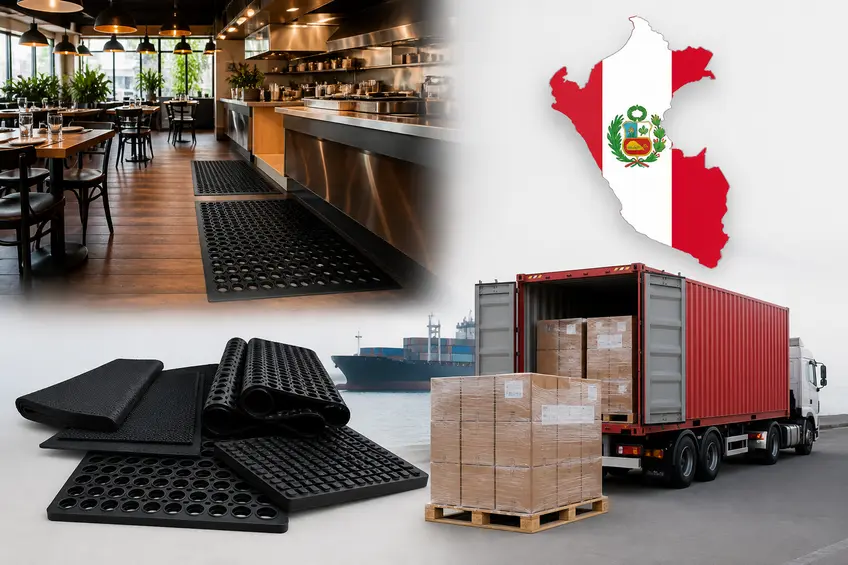
A restaurant rubber mat is more than a basic floor covering. When selected for the right work area, it can support safer movement, improve standing comfort, and protect the floor below. Its performance will depend on its rubber compound, surface pattern, edge design, and cleaning schedule.
Slip-Resistant Flooring for Wet and Greasy Areas
Dishwashing areas, beverage stations, and cooking lines often have different hazards. Water may be the main issue near a sink, while grease and cooking oil may affect the floor beside a fryer. Anti-slip restaurant mats should therefore be chosen for the contaminant found in each location.
No mat should be treated as completely slip-proof. Traction also depends on footwear, cleaning, drainage, and how quickly spills are removed. OSHA walking-working surface guidance is a useful safety reference. It stresses keeping walking areas clean, orderly, and as dry as reasonably possible.
Do Anti-Fatigue Kitchen Mats Help During Long Shifts?
Resilient anti-fatigue kitchen mats may reduce some discomfort caused by standing on hard tile or concrete for long periods. Their slight cushioning allows small changes in posture and foot movement. Ergonomic standing mats work best when combined with suitable footwear, good workstation design, and planned rest breaks.
Heavy-Traffic Floor Protection
Heavy-duty restaurant mats can help shield floors from repeated foot traffic, light trolley movement, dropped utensils, and routine cleaning. They should lie flat and remain stable during use. Raised or curled edges can create a trip hazard, especially in narrow service corridors.
Which Restaurant Rubber Mat Is Best for Each Area?
Drainage Rubber Mats for Sinks and Dishwashing Zones
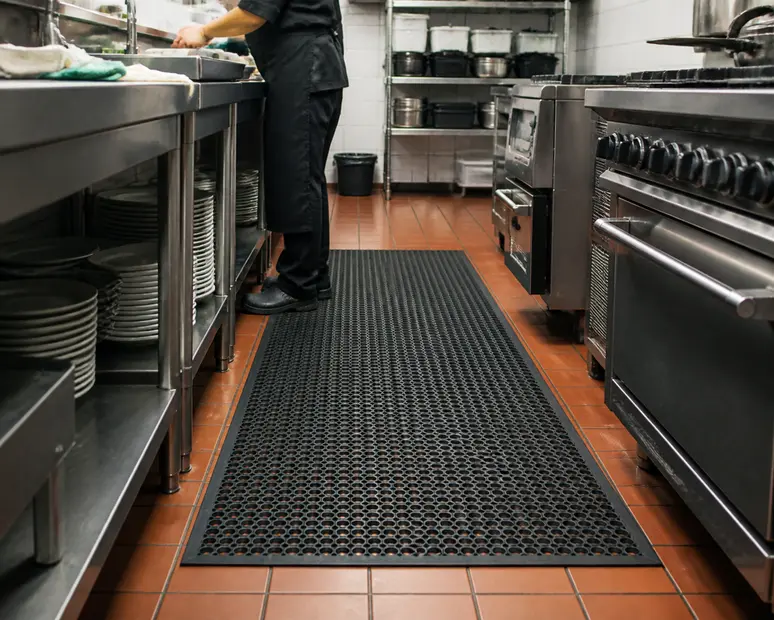
Open drainage rubber mats allow water and small particles to pass below the standing surface. Raised patterns can keep shoes above some surface liquid while underside channels help water move away. These mats still need to be lifted so staff can clean the mat and the floor beneath it.
Large drainage holes may not suit areas where narrow trolley wheels, small tools, or certain footwear are used. Buyers should compare hole size, surface texture, mat thickness, and the type of debris produced in the work area.
Grease-Resistant Rubber Mats for Cooking Lines
General-purpose kitchen rubber mats may degrade when they face regular oil exposure. Cooking lines often need grease-resistant rubber mats made from nitrile-rich or specially formulated compounds. Ask the supplier for product-specific oil-resistance information rather than assuming every rubber product performs in the same way.
Water-Resistant Mats for Bars and Service Counters
Bars and beverage counters often deal with water, milk, and drink spills but less cooking grease. Textured, water-resistant restaurant mats or solid-top waterproof rubber mats may suit these areas. A low-profile design can also reduce obstruction in compact spaces.
Commercial Hospitality Mats for Hotels and Cafes
Hotel and cafe flooring solutions can include mats for barista stations, entrances, service counters, preparation rooms, and back-of-house corridors. Product selection should reflect the amount of moisture, traffic, trolley use, and standing time in each space.
- Cooking line: Oil-resistant compound for grease exposure
- Dishwashing area: Open drainage design for standing water
- Bar: Textured, water-resistant surface for drink spills
- Preparation counter: Cushioned construction for standing comfort
- Service corridor: Heavy-duty, low-profile design for traffic
What Specifications Should Importers Compare?
Rubber Compound and Oil Resistance
Natural rubber, nitrile blends, synthetic compounds, and recycled rubber can have different performance traits. The right choice depends on contact with cooking oil, detergent, moisture, heat, and cleaning chemicals. Buyers should not choose commercial kitchen mats by unit cost alone.
Request the material composition and ask whether the quoted formulation is intended for frequent oil or grease exposure. Product data should relate to the exact model offered, not another item in the same range.
Thickness, Weight, and Edge Design
Thickness affects cushioning, height, weight, and ease of trolley access. A heavier mat may resist movement, but weight alone does not prove stability. Beveled edges can ease the transition between the floor and mat, while low-profile edges may work better along trolley routes.
- Check thickness and dimensional tolerance.
- Review product weight and movement resistance.
- Inspect edges for curling or lifting.
- Compare individual and interlocking formats.
- Confirm that doors, carts, and equipment have enough clearance.
Surface Texture and Drainage Pattern
Knobs, ribs, perforations, and molded textures affect grip and cleaning. Underside channels may improve drainage, while an open surface can make it easier for liquid to move below the worker’s feet. The pattern should not trap excessive food debris or make routine sanitation difficult.
Custom Restaurant Mat Sizes and Branding
Importers may need custom restaurant mat sizes for narrow lines, counters, or large washing areas. They can also ask about modular layouts, interlocking sections, colors, edge options, logo use, private labels, and export-carton markings. These choices may affect tooling, minimum order quantity, and lead time.
What Evidence Should a Supplier Provide?
- Technical data sheets and material details
- Slip-resistance results with the stated test method
- Oil- or grease-resistance information
- Recommended operating temperature range
- Product weight and size tolerances
- Cleaning and maintenance instructions
- Quality-control and production information
How Do You Choose a Rubber Mat Exporter to Peru?
Evaluate Manufacturing and Export Experience
First, confirm whether the business makes the product or trades goods made elsewhere. Ask about production capacity, available formulations, quality checks, and consistency across repeat orders. An international rubber mat export supplier should answer technical questions clearly and provide a detailed quotation.
Rubbmat is an Indian rubber mat manufacturer and international supplier that Peruvian buyers can contact when evaluating durable restaurant flooring solutions for Peru. Before ordering, request details for the exact products, materials, customization choices, and export terms available for your project.
Compare Samples Before a Bulk Order
A sample can reveal issues that are hard to judge from a description. Test it in the intended location under controlled operating conditions. Review grip, edge stability, odor, comfort, cleaning effort, and resistance to the contaminants used in that area.
Some rubber odor may reduce after unpacking and ventilation, but the level can vary by formulation. Ask for handling guidance and assess the sample before approving bulk rubber mats for hotels and restaurants.
Ask About MOQ, Lead Time, and Wholesale Terms
A quote from a wholesale restaurant mats supplier should state:
- Minimum order quantity and ordered quantity
- Unit price, currency, and quote validity
- Sample and customization charges
- Production lead time
- Packaging and pallet details
- Payment terms and agreed Incoterm
- Process for damaged or nonconforming goods
Clear communication matters after the sale as well. Check how the supplier provides production updates, shipping documents, claim support, and assistance with repeat orders.
How Are Commercial Kitchen Mats Exported to Peru?
Confirm Incoterms and Delivery Responsibilities
Incoterms define how key transport duties and costs are divided. Under FOB, the supplier delivers the shipment to the agreed origin port under the stated terms. Under CIF, the supplier arranges ocean freight and insurance to the destination port. DDP gives the seller broader delivery duties, subject to feasibility and local import arrangements.
Buyers should confirm which port charges, customs costs, taxes, and inland delivery fees are included. The three-letter term should always be shown with the named port or destination.
Prepare Export and Shipping Documents
- Commercial invoice
- Packing list
- Bill of lading or airway bill
- Certificate of origin when requested
- Insurance certificate under relevant terms
- Product specifications and agreed test documents
- Customs classification information
Verify HS Codes and Peruvian Import Rules
Rubber floor coverings may fall under HS 4016.91, depending on their material and construction. This is not a final classification. The importer should confirm the code, duties, taxes, labels, and current restrictions with SUNAT or a licensed customs broker before shipment.
Peru’s Ministry of Health, DIGESA, Law No. 29783, and current occupational safety rules are useful reference points. FDA Food Code guidance on durable, cleanable, and nonabsorbent floors can also offer context. These references do not replace current Peruvian legal, food-safety, or customs advice.
Plan Packaging and Delivery Through Callao
For delivery through the Port of Callao or another agreed location, confirm carton size, pallet dimensions, gross weight, net weight, and container use. Packaging should protect the mats from moisture and damage. If wood pallets are used, check whether ISPM 15-compliant material and related markings are required.
Practical Mat Selection Examples
High-Volume Restaurant Cooking Line
Problem: Frequent oil exposure, long standing periods, and heavy traffic. A heavy-duty, oil-resistant anti-fatigue mat with stable beveled edges may be suitable. Test a sample with the actual cleaning process before approving a full rollout.
Hotel Dishwashing Area
Problem: Continuous water, soap, and food debris. An easy-clean rubber mat with open drainage and a raised standing surface may help manage wet conditions. Staff must lift and sanitize both the mat and the floor on a set schedule.
Cafe Beverage Station
Problem: Water, milk, and beverage spills in a small space. A textured, water-resistant, low-profile mat may fit the area without blocking movement. Its dimensions should keep edges away from key traffic paths.
How Do You Request a Wholesale Quote?
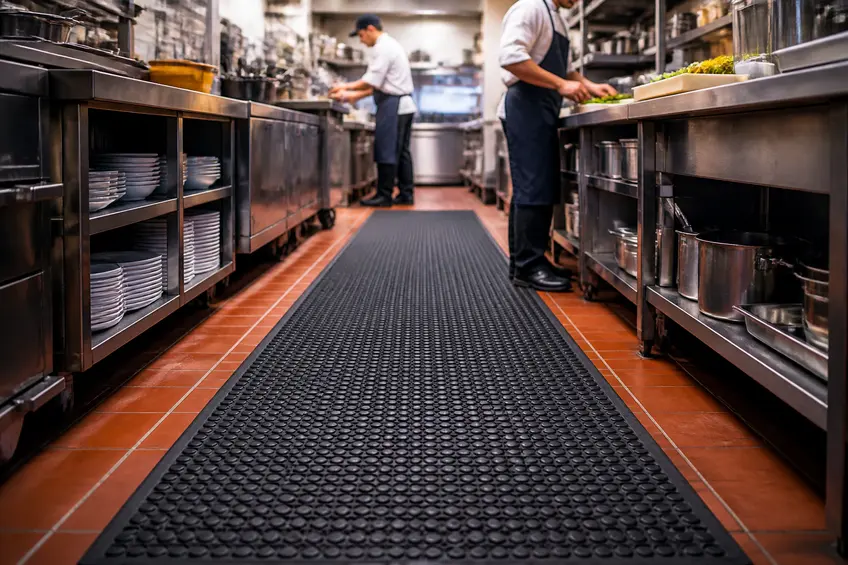
Give the restaurant mat supplier enough detail to recommend a suitable product and prepare a useful quote. Send the following information:
- Intended work area and operating conditions
- Required dimensions, thickness, and quantity
- Oil, grease, water, heat, or chemical exposure
- Solid-top or drainage preference
- Color, branding, and packaging requirements
- Destination city and port in Peru
- Preferred Incoterm and required delivery date
Ask whether a production sample is available, which tests support the quoted performance, and how tolerances are controlled. Buyers comparing a restaurant rubber mat exporter to Peru can visit Rubbmat to request product specifications, sample information, customization details, and a bulk export quotation.
Restaurant Rubber Mat Exporter to Peru
Choose the Right Mat for the Right Work Area
Effective restaurant flooring starts with a clear risk assessment. Match the rubber compound, drainage pattern, thickness, edges, and cleaning method to each location. Compare samples and product-specific evidence before committing to a large order.
A dependable exporter should provide clear specifications, transparent trade terms, suitable packaging, and consistent communication. Contact Rubbmat when comparing commercial hospitality mats, custom options, samples, and export supply for restaurants, hotels, and cafes in Peru.
Frequently Asked Questions
1. What is the best rubber mat for a commercial kitchen?
The best choice depends on grease, standing water, foot traffic, cleaning chemicals, and standing time. Grease-heavy areas often need a tested oil-resistant formulation. Wet washing zones may benefit from drainage holes, while preparation counters may need more cushioning.
2. Are rubber kitchen mats resistant to oil and grease?
Not all rubber compounds offer the same resistance. Frequent oil exposure may require nitrile-rich or specially formulated mats. Ask for test information that applies to the exact product quoted and confirm that it matches the kitchen’s oils, detergents, and cleaning routine.
3. Are drainage mats better for restaurant kitchens?
Drainage mats are useful in wet zones because liquid can move below the standing surface. They are not automatically better for every area. Hole size, debris, footwear, and trolley use matter, and both sides of the mat require regular cleaning.
4. Can restaurant mats be customized for hotels in Peru?
Buyers can ask about custom dimensions, colors, edge designs, interlocking formats, branding, and export packaging. Availability will depend on the supplier’s production options, tooling needs, order volume, and minimum order quantity.