Wet, exposed, or heavily used ramps can become a serious safety risk. A standard floor mat may move, curl, hold water, or make wheeled access harder. Peruvian importers and project contractors need a ramp rubber mat designed for the site, traffic level, and installation method.
When choosing a ramp rubber mat exporter to Peru, buyers should compare traction, drainage, dimensions, test records, packaging, and shipping support. This guide explains the main specifications, applications, sourcing steps, import documents, installation methods, and maintenance needs. Buyers can also contact Rubbmat to discuss product options and request an export quotation.
Why Ramp Safety Matters in Peru
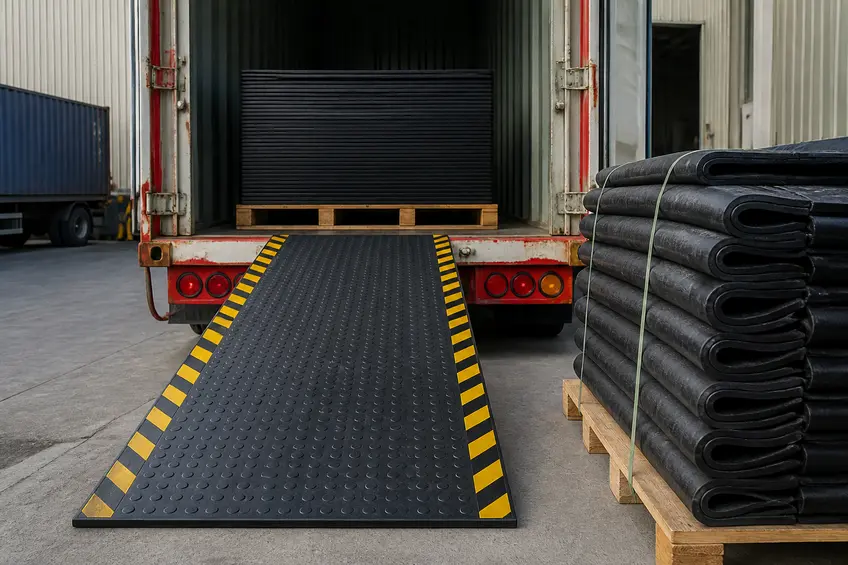
Ramps at hospitals, shops, offices, factories, hotels, and apartment buildings often face rain, dirt, dust, and constant traffic. On an incline, even a small loss of grip can increase the chance of a fall. Poorly fitted mats can also create raised edges that affect pedestrians, wheelchairs, and carts.
How does an anti-skid rubber surface reduce risk?
An anti-skid rubber surface creates more contact and grip than smooth concrete or tile. Textured designs can help shoes and wheels maintain traction when the ramp is damp. Drainage channels may also move water away from the main travel path.
However, no mat should be described as completely slip-proof. Safe use depends on the ramp slope, drainage, footwear, cleaning routine, mat condition, and fixing method. The whole ramp system must be reviewed.
Where are wheelchair ramp mats commonly used?
- Hospitals, clinics, and care facilities
- Shopping centers, hotels, and restaurants
- Schools, offices, and public buildings
- Apartment and building entrances
- Transit stations and parking facilities
Good wheelchair ramp mats should stay flat and firm under rolling loads. They must not narrow the route or create sudden edge changes. Accessibility ramp flooring should also suit the ramp gradient and applicable building rules.
Specifications of a Reliable Ramp Rubber Mat
A clear technical request helps a rubber mat supplier recommend a suitable product. Buyers should explain where the mat will be used, who will travel over it, and what conditions it will face.
Which surface pattern offers better traction?
Ribbed, studded, diamond, and other textured patterns serve different needs. Directional ribs can provide useful grip on an incline. Studded or raised textures may support traction in busy entrances. Drainage channels can help on covered outdoor ramps where water is common.
Do not rely only on an “anti-slip” label. Ask for a test report that states the method, surface condition, test direction, and result. This allows buyers to compare anti slip rubber mats on a more reliable basis.
How thick should rubber ramp mats be?
There is no single thickness for every ramp. The correct choice depends on foot traffic, wheelchair use, trolley loads, substrate condition, and threshold clearance. A mat that is too thick may create a difficult edge transition. One that is too light may shift or wear early.
For heavy-duty rubber mats, ask the supplier to review:
- Ramp dimensions and gradient
- Expected load and traffic frequency
- Door, curb, and threshold clearance
- Need for beveled or tapered edges
- Adhesive or mechanical fixing options
Are weather-resistant rubber mats suitable outdoors?
Outdoor rubber ramp mats may face rain, sunlight, heat changes, and moisture below the surface. Buyers should ask about water resistance, aging behavior, and UV exposure. Drainage below the mat is important because trapped moisture can cause odor, movement, or mold around the installation area.
Natural, synthetic, and recycled-rubber compounds may perform differently. Recycled content alone does not prove that a product is eco friendly rubber flooring. Ask for a material declaration and performance data before making environmental claims.
What determines rubber mat durability?
Rubber mat durability depends on the formulation, hardness, flexibility, tear strength, abrasion resistance, edge quality, and production consistency. Industrial rubber mats for heavy traffic areas should also recover well after repeated loads without cracking or staying compressed.
Commercial and Industrial Applications
Warehouse and factory applications
Bulk ramp mats for industrial applications can be used at loading entrances, employee walkways, maintenance zones, and internal access ramps. They may also suit production or utility areas exposed to water, dirt, or light oils. Chemical and oil compatibility should always be confirmed for the chosen rubber compound.
Industrial safety flooring must suit both people and equipment. A surface that works for walking may not be ideal for small trolley wheels. Buyers should provide wheel type, load, travel direction, and traffic frequency during product selection.
Commercial ramp mat solutions for Peru
Commercial ramp mat solutions for Peru can support retail entrances, offices, hotels, schools, healthcare buildings, parking areas, and sheltered access points. Safety ramp mats should be selected for the actual environment rather than by appearance alone.
What does a real-world assessment involve?
Consider a distribution site in coastal Peru with a covered loading entrance. The ramp faces moisture and daily trolley traffic. A practical selection process would include:
- Measure the ramp, slope, thresholds, and available edge clearance.
- Identify pedestrian, wheelchair, and trolley movement.
- Select a textured surface with suitable drainage.
- Review tapered edges where they improve access.
- Choose an approved adhesive or mechanical fixing method.
- Request a sample and technical data before bulk ordering.
How to Choose a Rubber Mat Exporter to Peru
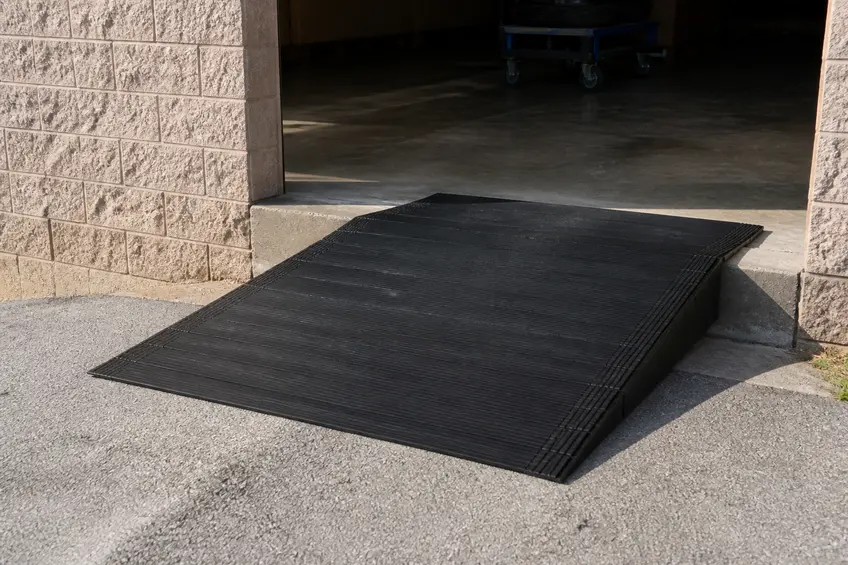
Is the supplier a manufacturer or only a trader?
Ask whether the supplier is a rubber mat manufacturer, an exporter, or a trading business. Direct manufacturers may offer closer control over dimensions, compounds, surface patterns, and batch consistency. They may also provide faster technical answers for custom projects.
Do not assume that every exporter owns a factory. Request clear information about production, quality checks, customization, and responsibility for claims. Buyers looking for the best ramp rubber mat supplier from India should use measurable criteria instead of unsupported “best” claims.
What quality documents should buyers request?
- Product technical data sheet
- Material composition declaration
- Dimensions and tolerance details
- Hardness and physical-property results
- Abrasion or accelerated-aging data, where relevant
- Slip-test report with the stated method
- Pre-shipment inspection and quality-control records
- Packaging and country-of-origin documents
ISO or ASTM methods may be relevant to abrasion, aging, tensile properties, hardness, or slip performance. The report should identify the exact method and test conditions. A standard name without a result offers little value.
How should suppliers be compared?
A simple scorecard can make supplier selection more objective:
- Product suitability: 25%
- Test documentation: 20%
- Manufacturing and quality control: 20%
- Export capability: 15%
- Commercial terms: 10%
- Communication and support: 10%
Custom and Wholesale Rubber Ramp Mats
Are custom-size rubber mats available?
Custom production may include length, width, thickness, color, texture, drainage pattern, and edge profile. Some projects may also request safety markings, logo embossing, private labeling, rolls, modular pieces, or individual mats. Availability should be confirmed before the order is placed.
Custom products may require tooling and a larger minimum order. They can also need more time for sampling and approval than standard mats.
What affects a wholesale quotation?
A wholesale rubber ramp mats supplier will normally review the compound, dimensions, quantity, tooling, packaging, testing, and shipping terms. The minimum order may differ for standard and custom products.
What should a wholesale RFQ include?
- Application and installation location
- Indoor, outdoor, or covered-outdoor use
- Ramp measurements and gradient
- Traffic type and expected volume
- Exposure to water, oil, chemicals, or sunlight
- Required size, thickness, color, and edge design
- Destination city and preferred port in Peru
- Estimated order quantity and target date
- Required reports and import documents
- Preferred Incoterm
This information helps an international rubber mat export supplier prepare a clearer technical and commercial offer.
Exporting Rubber Ramp Mats to Peru
What documents are commonly required?
- Commercial invoice
- Packing list
- Bill of lading or airway bill
- Certificate of origin, when requested
- Product data sheet
- Insurance documents, when applicable
- Inspection or test reports
- Other documents required by the importer or SUNAT
Rubber floor coverings and mats may fall under HS 4016.91, but classification depends on the exact product. Confirm the code, taxes, and current import rules with SUNAT or a licensed Peruvian customs broker. INACAL guidance and Peru’s current accessibility rules, including relevant provisions such as Norma A.120, should also be checked where applicable.
Which shipping option is suitable?
Sea freight is often practical for pallets, wholesale orders, and full containers. Air freight may suit samples, urgent replacements, or small consignments. Freight planning should consider product density, pallet size, port handling, and inland transport.
How should importers compare quotations?
Compare total landed cost rather than unit price alone. Include tooling, export packaging, inland transport, freight, insurance, customs clearance, duties, taxes, and delivery to the site. For FOB, CIF, or other Incoterms, define each party’s duties in the purchase contract.
Installation and Maintenance Best Practices
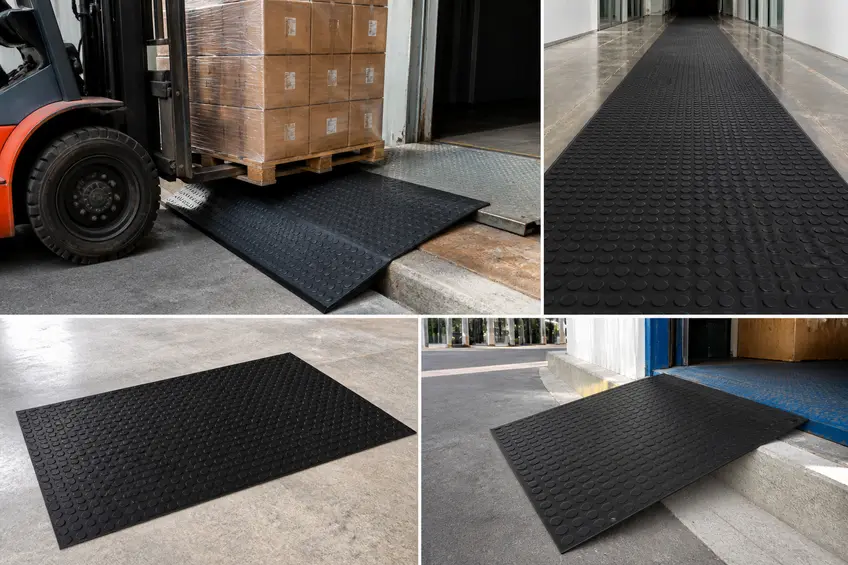
How are safety ramp mats installed?
- Inspect the ramp for cracks, moisture, and contamination.
- Clean and dry the surface.
- Lay out the mat and check its direction and fit.
- Trim only with suitable tools and supplier approval.
- Use an approved adhesive, fixing system, or recessed installation.
- Check that edges cannot curl or become trip hazards.
- Test the ramp under expected foot and wheeled traffic.
Safety mat installation should follow product instructions and local building and accessibility requirements. Secure fixing is vital on an incline.
What rubber flooring maintenance solutions work?
- Sweep or vacuum loose dirt.
- Use a compatible, non-aggressive detergent.
- Avoid solvents that have not been approved.
- Keep drainage paths open.
- Remove oil and chemical spills at once.
- Inspect seams, edges, and fixings.
- Replace mats with major cracks, curling, or surface wear.
Busy or wet ramps may need daily visual checks. Documented inspections can be scheduled based on risk. Carry out added checks after heavy rain, cleaning, construction work, or movement of large loads.
Ramp Rubber Mat Exporter for Peru
Choose Ramp Mats on Evidence, Not Price Alone
Selecting a ramp rubber mat exporter to Peru requires more than comparing unit costs. Traction, drainage, dimensions, edge design, installation, quality records, and export documents all affect safety and long-term value.
Looking for durable rubber mats for accessibility ramps, commercial entrances, or industrial facilities in Peru? Contact Rubbmat with your ramp dimensions, application, quantity, and delivery location to request a product recommendation and export quotation.
Frequently Asked Questions
1. What is the best rubber mat for an outdoor ramp?
The best option has suitable traction, drainage, weather resistance, stable edges, and enough strength for expected traffic. It should also fit the ramp without blocking drainage or creating a raised transition. Request test data for the proposed product.
2. Are rubber ramp mats safe for wheelchairs?
They can be suitable when they stay flat, firm, and securely fixed. The surface should allow smooth wheeled movement and match the ramp slope. Final selection must follow local accessibility requirements and the needs of the site.
3. Can ramp mats be customized for commercial projects?
Possible options may include custom dimensions, thicknesses, patterns, colors, drainage channels, beveled edges, logos, and packaging. Minimum order and tooling needs depend on the design. Confirm all specifications with the supplier.
4. How do I verify an anti-slip rubber mat?
Ask for a report that lists the test standard, laboratory, surface condition, direction, and measured result. Avoid unsupported claims such as “100% non-slip.” Real performance also depends on installation, drainage, cleaning, and wear.